How Transparent Are Residential Proxy Plans Before Purchase?
Research data and reproducibility materials: https://doi.org/10.5281/zenodo.21725645
A reproducible audit of 22 providers and 264 decision-relevant claims from official public sources.
One in five decision fields remained unresolved before payment
Across 264 required observations, 65.9% were fully confirmed from official public sources. Including conditional evidence, 80.7% were documented; 19.3% remained unknown or conflicting before payment.
What this study measured
ProxyBuyerGuide audited what a prospective buyer could verify from official public sources before paying for a residential proxy product. The study covered 12 decision-relevant dimensions for each eligible provider: plan identity, entry cost, billing basis, included traffic or capacity, geography and targeting, rotation and session controls, protocols, authentication, trial terms, refund terms, billing and renewal, and acceptable-use limits.
Scope: The study did not test proxy speed, success rate, IP quality, support quality, or overall provider value. It therefore does not identify the “best” provider.
Key findings
Most information was documented, but not always fully. 174 of 264 observations were fully confirmed (65.9%). Another 39 were conditional (14.8%), usually because the claim applied at product level, depended on a condition, or was not clearly tied to the selected entry plan.
One in five decision fields remained unresolved. Forty-eight observations were unknown and three were conflicting. Together, these 51 observations represented 19.3% of the study.
Entry cost was usually visible. A minimum purchase or other confirmable entry cost was found for 18 of 22 providers (81.8%). A displayed per-unit rate was not treated as proof of the minimum initial payment.
Refund terms were the largest information gap. Refund information was documented for only 6 of 22 providers (27.3%). Fifteen refund observations were unknown and one was conflicting.
Complete documentation was uncommon. Only 2 of 22 provider records had all 12 dimensions documented without an unknown or conflict. This is a completeness observation, not a quality score.
Transparency by decision dimension
“Documented” combines fully confirmed and conditional observations. “Unresolved” combines unknown and conflicting observations. Every dimension uses the same denominator: 22 eligible providers.
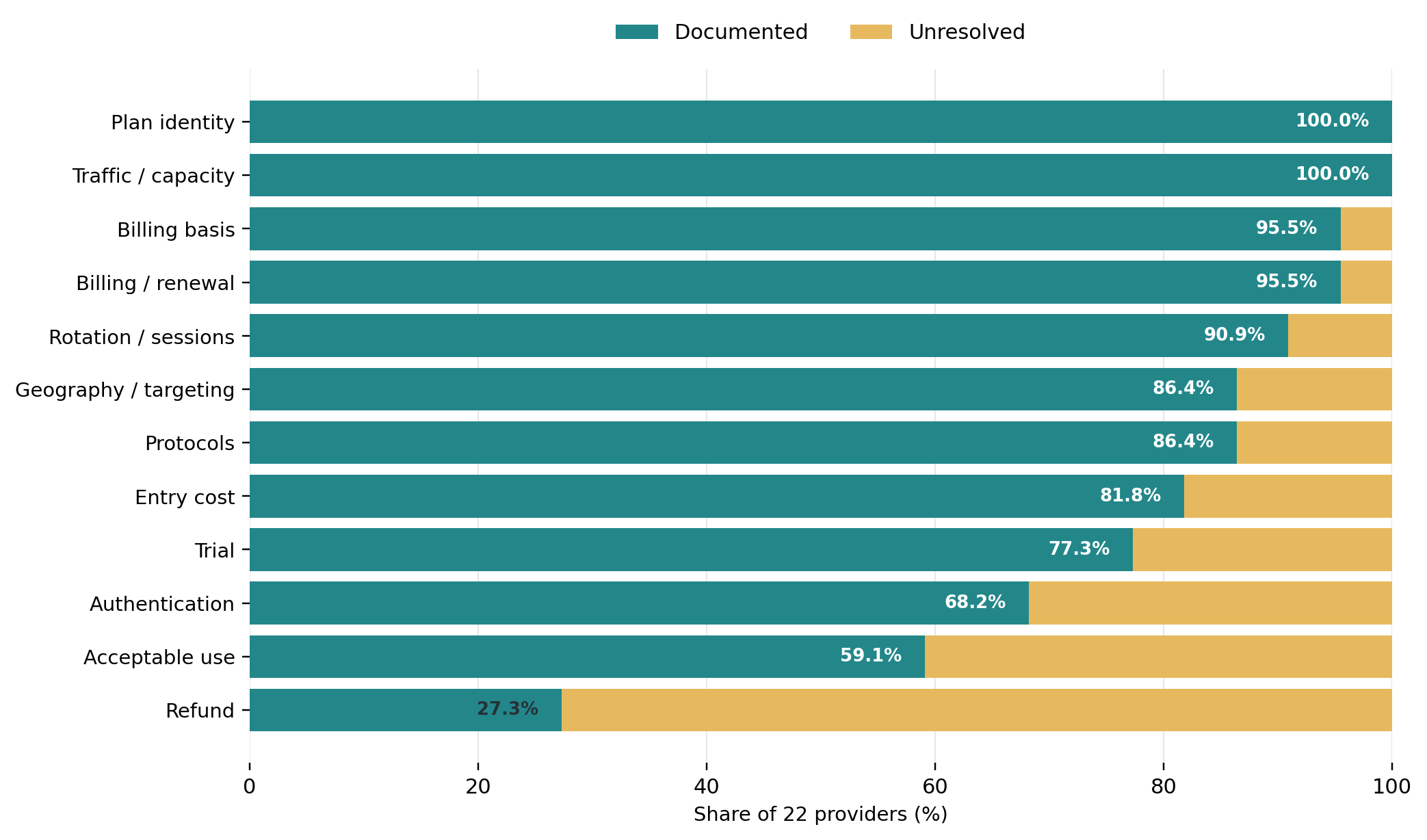
Figure 1. Share of eligible providers with documented versus unresolved pre-purchase information, by dimension (n = 22).
| Decision dimension | Confirmed | Conditional | Unknown / conflicting | Documented share |
|---|---|---|---|---|
| Plan identity | 18 | 4 | 0 | 100.0% |
| Entry cost | 18 | 0 | 4 | 81.8% |
| Billing basis | 19 | 2 | 1 conflict | 95.5% |
| Traffic / capacity | 20 | 2 | 0 | 100.0% |
| Geography / targeting | 15 | 4 | 3 | 86.4% |
| Rotation / sessions | 19 | 1 | 2 | 90.9% |
| Protocols | 16 | 3 | 3 | 86.4% |
| Authentication | 15 | 0 | 7 | 68.2% |
| Trial | 11 | 6 | 4 unknown + 1 conflict | 77.3% |
| Refund | 1 | 5 | 15 unknown + 1 conflict | 27.3% |
| Billing / renewal | 15 | 6 | 1 | 95.5% |
| Acceptable use | 7 | 6 | 9 | 59.1% |
Source: ProxyBuyerGuide research workbook v1.8; separate analysis QA checks passed; snapshot dated July 31, 2026. DOI: 10.5281/zenodo.21725645.
How to interpret the results
A confirmed field means the selected official public source directly supported the claim. A conditional field means the information was official but depended on a stated condition, applied at a broader product level, or could not be tied unambiguously to the selected entry plan. Unknown means the required fact could not be verified from the retained official sources. Conflicting means official sources disagreed.
Important: Documentation completeness is not the same as network quality. A provider can disclose less information and still deliver a strong product, or disclose more information and still perform poorly.
Different purchasing models require separate interpretation
Three services in the eligible sample—Scrape.do, ScraperAPI, and Zyte—provide residential access through an API-based service rather than a conventional gigabyte-based proxy plan. Their credits, request pricing, or API access terms should not be compared directly with ordinary residential proxy packages.
Methodology
The frozen candidate roster contained 27 providers represented in ProxyBuyerGuide’s research scope on July 31, 2026. A provider was eligible only when a current official source showed a residential proxy product available to new customers. Twenty-two providers met that rule; five were excluded because an identifiable current residential product could not be confirmed from official sources.
For every eligible provider, ProxyBuyerGuide recorded 12 required dimensions using a source hierarchy: plan or checkout pages for price and package details; product documentation for technical facts; and official refund, billing, Terms, and acceptable-use pages for policy claims. Claims were coded as CONFIRMED, CONDITIONAL, UNKNOWN, or CONFLICTING. Missing information was never inferred from another plan or provider.
Providers included in the audit
Bright Data, Crawlbase, DataImpulse, IPCook, IPRoyal, Infatica, InstantProxies, LokiProxy, NodeMaven, Oxylabs, Proxidize, Proxy-Cheap, Proxying, ProxyScrape, proxys.io, RapidProxy, Rayobyte, Scrape.do, ScraperAPI, SOAX, Webshare, and Zyte.
Candidates excluded by the eligibility rule
Proxy-n-VPN, Proxy6, Proxyline, SpaceProxy, and TakeProxy. Exclusion means only that the required current residential product could not be confirmed from official public sources under this study’s rule; it is not a judgment about the company or its other services.
Reproducibility and evidence
The final dataset contains 264 required observations and 265 retained evidence rows. The extra evidence row preserves a second official IPCook refund source for one conflicting observation; it is not double-counted in the percentages. Fifty-two distinct official URLs were retained in the full-collection source archive with access dates and SHA-256 integrity values. Counts, denominators, status shares, provider totals, and dimension totals passed separate analysis QA checks.
Limitations
- Point-in-time evidence. Provider pages and policies can change after the July 31, 2026 snapshot.
- Official sources only. The audit did not use third-party reviews, private dashboards, sales conversations, or post-purchase account screens as substitutes for public pre-purchase evidence.
- One selected offering per provider. The study audited one identifiable residential offering or API access model per eligible provider; it did not exhaust every plan variant.
- No performance testing. No speed, success-rate, latency, IP-quality, support, or value-for-money claim can be derived from this dataset.
Suggested citation
ProxyBuyerGuide. (2026). How Transparent Are Residential Proxy Plans Before Purchase? A Reproducible Audit of 22 Providers and 264 Decision-Relevant Claims. https://doi.org/10.5281/zenodo.21725645
Research data and reproducibility materials: https://doi.org/10.5281/zenodo.21725645